
Ask a random person on the street what they know about chiropractic, and it will often be described as “cracking backs” or “popping backs”. Look up videos of chiropractic care and you’ll get hundreds of YouTube and TikTok videos full of nothing but chiropractors adjusting patients with microphones carefully set up to capture the loud, dramatic snap-crackle-pops that result. If you’ve been to a chiropractor yourself, or even if you haven’t, chances are good you’ve experienced joints “popping” yourself, and you may have even heard it described as “self-adjusting”. But what exactly is creating that noise, and more importantly, does it actually tell you anything about the quality of an adjustment?
First, A Quick Anatomy Lesson
First, we have to understand the basic anatomy of what a joint is exactly. A joint, at its simplest, is the place where two bones meet, and usually (though not always) where they move against each other (or “articulate”). There are several types of joint in the body, but the one we’re going to focus on here is the most common one and the one that’s capable of producing those often-loved cracks and pops: synovial joints.
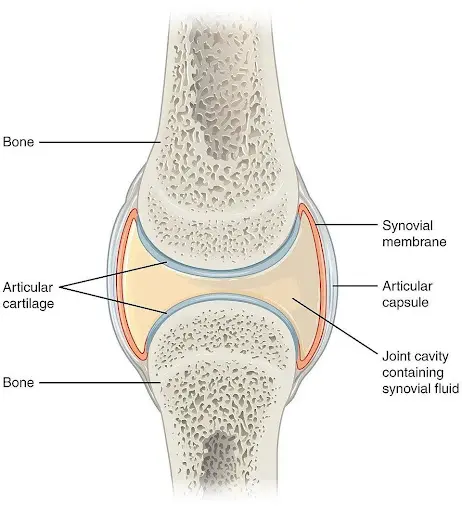
A synovial joint, in brief, consists of the two bones that are meeting, each capped by smooth articular cartilage, joined by a connective tissue articular capsule (or joint capsule), which completely surrounds the joint and is lined by a synovial membrane, which helps keep it completely sealed and as frictionless as possible. Inside that capsule is held synovial fluid, the thin, slippery liquid which is the star of our show.
Synovial fluid is the lubricant that keeps joints moving smoothly and painlessly, making the joint as low-friction as possible and separating the articular cartilage to prevent it from being rubbed away over time and pressure. Synovial fluid is crucial to joint health, and fortunately it’s very well-protected in the joint capsule.
So What’s Making Noise?
In short, it’s a physics trick.
When a joint is stretched to its limit, the joint capsule stretches with it, and by stretching forces a pressure drop inside the joint capsule. Nature hates a vacuum, and so to try to fill the now-larger space, the molecules of fluid have to spread farther apart — which eventually forces them to become a gas instead of a liquid. Thus, bubbles form inside the synovial fluid — and it’s the wet surfaces of those bubbles peeling apart from each other that creates the “cracking” sound you hear when a joint “pops”. This is properly called cavitation, which is why those “pops” and “cracks” are in quotation marks.
At that point, the joint has typically stretched as far as it will go without being damaged, and since those bubbles have already formed, the joint can’t “pop” again until the gas eventually goes back into solution (that is, becomes entirely liquid again). That’s why if you get a joint to “pop,” it typically won’t make noise again for 15–20 minutes — at least if the popping noise is due to cavitation. (In cases where a joint will pop over and over again every time you take it through a given movement, that’s more likely to be an overly tight muscle or tendon getting strummed back and forth over a bony prominence, like plucking a guitar string.)
Why This Matters to Adjusting (Or Rather, Why It Doesn’t)
Because cavitations come from a joint being stretched, and one of the goals of adjustments is to stretch joints which aren’t moving through their full range of motion, adjustments often produce the “pops” and “cracks” that come from joint cavitation. However, most chiropractors will tell you if asked that not getting a “pop” does not mean the adjustment didn’t work. (And conversely, the noise happening doesn’t necessarily mean that it did work — which is part of why “self-adjustments” consisting of cracking your own joints at home usually aren’t helpful in the long run.)
The trick is, cavitations come from a joint being stretched to its maximum, and thus joints that already have a large range of motion are the most likely joints to create cavitations and make noise — and adjustments typically target joints that aren’t moving enough, not the ones which already have that large range of motion. Because of that, while adjustments often do cause joint cavitation, these cavitations are usually happening not in the joint being targeted, but in its neighbors, which are often also affected by a given adjustment. While it often may feel like those “pops” are happening right under the chiropractor’s hands, the truth is that it’s very difficult for either patient or chiropractor to tell where a joint cavitation originated from by feel, because of how well muscle and fat transmit vibration. Cavitations may even be several inches away from the chiropractor’s hand contact (as detected by high-sensitivity microphones) but still feel to both patient and practitioner as if they happened directly beneath it.
So: if you’ve been to a chiropractor before and been frustrated by a lack of cracks and pops, or feel you’re “hard to crack,” don’t be discouraged! A lack of noise doesn’t necessarily mean the adjustment isn’t effective. While joint cavitations are psychologically satisfying (and suspected to cause a small endorphin rush, making them feel good even if only temporarily), they aren’t something that chiropractors typically pursue as a goal; instead, most chiropractors prefer to focus on your pain levels and ability to function in daily life, as well as the palpable movement of the joints in question, to determine the effectiveness of treatment. Don’t get too caught up on chasing pops — if you’re feeling better and moving better, that’s what ultimately matters most.